Industry Insights

A close-up view of an industrial control panel on a factory floor features a rugged Windows tablet connected to a PLC via a DB9 serial cable, showcasing realistic metal textures and natural indoor lighting. The tablet displays a subtle KCOSIT wordmark and highlights the distinct advantages of communication protocols such as RS232 and RS485 in industrial applications, emphasizing data transmission and noise immunity.

RS232 vs RS485: Which Serial Interface Fits Rugged Tablets and Industrial PCs?

RS232 vs RS485 comes down to communication range, wiring topology, and electrical noise. RS232 is usually better for short-distance point-to-point serial communication, while RS485 is usually better for longer cable runs, noisy industrial environments, and multi-device networks. For system integrators, maintenance engineers, automation teams, field service teams, and procurement teams, the practical question is not

RS232 vs RS485: Which Serial Interface Fits Rugged Tablets and Industrial PCs? Read More »

The image depicts a comprehensive Hardware, Software, and Deployment Guide for a barcode inventory system, featuring illustrations of barcode scanners, labels, and a mobile app interface for inventory management. This guide aims to assist small businesses in tracking inventory levels and managing stock efficiently using real-time data and barcode scanning technology.

Barcode and Inventory System: Hardware, Software, and Deployment Guide

Key Takeaways A barcode and inventory system combines barcode labels, scanning devices, inventory software, and defined workflows for receiving, picking, counting, shipping, and asset tracking. For B2B teams, the buying decision should include hardware risk, not only software features. Choose scanners, rugged handhelds, rugged tablets, IP rating, drop protection, connectivity, battery, and docking based on

Barcode and Inventory System: Hardware, Software, and Deployment Guide Read More »

A close-up image depicts a warehouse worker in industrial gloves, scanning a long linear Code 39 barcode on a cardboard shipping box with a rugged Android tablet, highlighted by a distinct red laser aiming beam. The tablet features KCOSIT branding with blue and orange accents, all under natural indoor lighting that casts realistic shadows.

Code 39 Barcodes: Format, Examples, and Industrial Scanning Guide

Key Takeaways A Code 39 barcode, also called Code 3 of 9, is a 1D linear barcode for alphanumeric data, with an asterisk start/stop character and optional check digit. Code 39 barcodes are widely used in inventory, manufacturing, logistics, healthcare equipment, government, asset tracking, and non-retail industrial labels. Code 39 is simple to print and

Code 39 Barcodes: Format, Examples, and Industrial Scanning Guide Read More »

A close-up image shows a worker's hand, wearing industrial gloves, holding a rugged handheld barcode scanner aimed at a cardboard box with a visible red laser beam. The background features a blurred view of warehouse racks, emphasizing the barcode scanning process in an industrial setting.

Reading Barcodes: How to Read Barcode Numbers, Types, and Scanner Workflows

Reading barcodes means decoding printed or digital barcode patterns into usable data, such as a universal product code, serial number, lot code, or asset ID. For procurement teams, warehouse operators, logistics teams, and field service teams, reliable barcode interpretation depends on barcode type, barcode number structure, check digit validation, scanner compatibility, rugged handheld durability, connectivity,

Reading Barcodes: How to Read Barcode Numbers, Types, and Scanner Workflows Read More »

The image depicts a comprehensive guide featuring various types of barcodes, such as linear and two-dimensional barcodes, along with standards used in global trade for effective supply chain management. It highlights the importance of barcodes in product identification, inventory management, and consumer engagement across industries like retail and healthcare.

GS1 Barcodes: Complete Guide to Types, Standards, and Use in Global Trade

Key Takeaways GS1 barcodes are standardized barcodes that use the global trade item number, application identifiers, and other GS1 keys to uniquely identify products worldwide. There are several types: linear barcodes such as universal product code, EAN, GS1 128, ITF-14, and GS1 DataBar, plus 2d barcodes such as GS1 DataMatrix and QR code. Barcodes improve

GS1 Barcodes: Complete Guide to Types, Standards, and Use in Global Trade Read More »

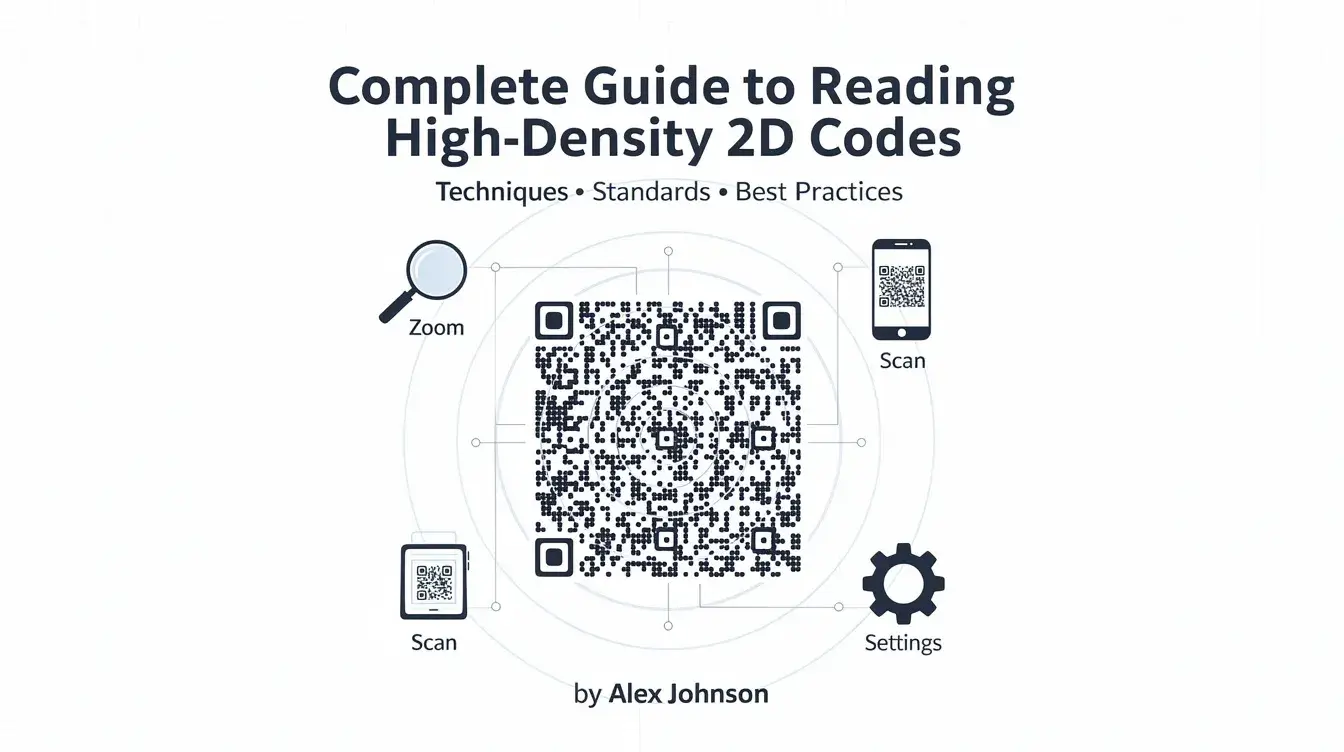
The image depicts a comprehensive guide on reading high-density 2D codes, specifically focusing on data matrix codes and their applications in various industries like retail and healthcare. It includes visuals of a data matrix code reader and examples of small electronic components, highlighting features such as error correction and the importance of quiet zones for accurate scanning.

Data Matrix Scanner: Complete Guide to Reading High-Density 2D Codes

A data matrix scanner reads compact 2D identifiers when a normal barcode is too large or too limited. For buyers, the right scanner depends on code size, surface, lighting, software settings, and the data workflow after each scan. Introduction to Data Matrix Scanners A data matrix scanner is a camera-based barcode reader, often with LED

Data Matrix Scanner: Complete Guide to Reading High-Density 2D Codes Read More »

The image depicts a comprehensive guide on Direct Part Marking (DPM) and scanning techniques, featuring various marking methods such as laser marking and dot peen marking, used for reliable identification of components in the automotive and aerospace industries. It highlights the importance of permanent marks like data matrix codes and QR codes for tracking parts throughout their entire lifecycle in challenging environments.

DPM Barcodes: Complete Guide to Direct Part Marking & Scanning

Key Takeaways A DPM barcode is a machine-readable code, usually a data matrix code, marked directly on industrial parts for lifetime traceability. Common direct part marking DPM methods include laser marking, laser etching, dot peen marking, chemical etching, engraving, and other permanent techniques for metal, plastic, glass, and ceramics. DPM barcodes are essential in automotive,

DPM Barcodes: Complete Guide to Direct Part Marking & Scanning Read More »

In this photorealistic image, an over-the-shoulder view shows a worker in industrial gloves scanning a package with both a standard QR code and a high-density Data Matrix code using a rugged tablet. The scene is illuminated by natural indoor lighting, highlighting the tablet's KCOSIT branding and the complex data encoded in the two-dimensional barcodes.

2D Barcode vs QR Code: Understanding the Key Differences for Your Business

Choosing between 2D barcodes and QR codes affects data capacity, scanning compatibility, durability, and application suitability. QR codes are actually a specific type of 2D barcode, but not all 2D barcodes are QR codes. The right choice depends on your scanning environment, data requirements, and whether you need consumer or industrial applications. Below is a

2D Barcode vs QR Code: Understanding the Key Differences for Your Business Read More »

Scroll to Top

Configure Your Rugged Tablet

Tell us your application requirements and our engineers will recommend the right configuration.
1. Application
2. Operating System
3. Screen Size
4. Protection Level
5. Modules & Accessories
Your Inquire will be sent to :
sales@kcosit.com