







Key Takeaways
- A taxi dispatch MDT (mobile data terminal) is a vehicle-mounted computer that connects drivers, vehicles, and the central dispatch system in real time, replacing voice radio with digital job management, navigation, and status updates.
- Modern digital dispatch systems running on rugged Android or Windows tablets improve fleet efficiency by enabling drivers to handle more trips per shift while reducing manual errors in booking, address locating, and dispatching.
- Hardware specifications matter for 2024–2026 deployments: look for GPS receivers, 4G/LTE connectivity, CAN-bus integration, panic button support, camera interfaces, taximeter connections, and 700–1000 nit sunlight-readable displays.
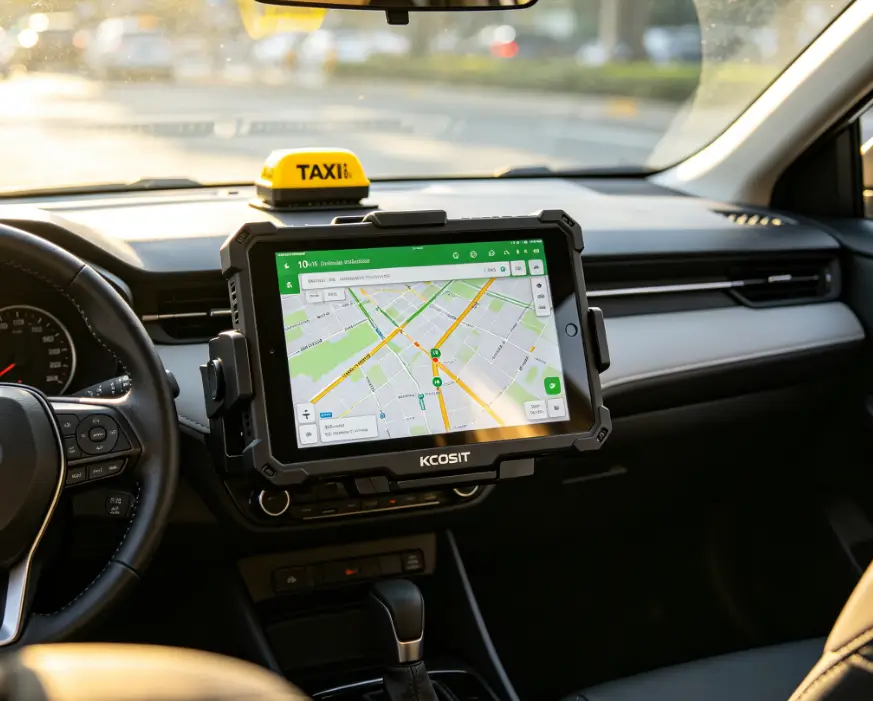
- Kcosit rugged vehicle-mounted tablets serve as reliable MDT hardware for taxi fleets, offering IP-rated protection, MIL-STD-style durability, wide-voltage vehicle power (9–36V DC), and support for multi-year fleet deployments.
- Successful MDT deployment depends on careful pilot testing, professional installation standards, driver training, and ongoing performance monitoring—not just hardware selection.
Introduction: From Radio Cabs to Digital Taxi Dispatch
The taxi industry has undergone a fundamental transformation in how drivers receive and manage trip assignments. What began with manual telephone operators and two-way voice radio in the mid-20th century has evolved into fully digital taxi dispatch systems powered by mobile data terminals. This shift from analog to digital has redefined operational efficiency, driver safety, and customer service quality across global taxi fleets.
Concrete milestones mark this evolution. Early computerized dispatch systems emerged in the 1970s–1980s, with alphanumeric pagers delivering basic job alerts. By the 1990s, dedicated mobile data terminal MDT units appeared in fleets like Yellow Cab of Chicago, transmitting encrypted trip data at 4800 bps. After 2010, GPS integration became standard as smartphone ubiquity drove chipset costs below $10 per unit. The most significant recent shift occurred after 2018, when rugged Android tablets surged in urban fleets—adoption increased 300% according to 2022 ABI Research data. Modern digital dispatch systems now reduce voice radio dependency by 80–90% in well-equipped fleets.
A mobile data terminal in the taxi context is an in-vehicle, networked computer used to receive job offers, navigation instructions, safety alerts, and back-office communications. Unlike consumer devices, these terminals feature semi-permanent docking stations, vehicle power integration, and extended I/O for connecting taximeters, cameras, and panic buttons. Enhanced operational efficiency streamlines operations by automating manual processes, allowing for quicker dispatch and reduced downtime between jobs.
Kcosit provides rugged Android and Windows vehicle-mounted tablets for fleet management commonly deployed as MDTs in taxi, limo, and broader transportation industry fleets across the US, UK, EU, Canada, and Australia. This guide serves fleet managers, system integrators, dispatchers, and taxi operators evaluating or upgrading their taxi dispatch system hardware—covering everything from core MDT functions to practical selection criteria and deployment tips.

What Is a Taxi Dispatch MDT (Mobile Data Terminal)?
A taxi dispatch MDT is a mobile data terminal permanently or semi-permanently installed in a taxi to interface with the central dispatch system. Unlike handheld devices or smartphones used casually, the MDT serves as the driver’s primary digital workstation throughout each shift, receiving job assignments, sending status updates, and providing navigation—all without voice radio communication.
Core MDT Functions
The essential functions of a taxi mobile data terminal include:
- Job offer display: Incoming jobs appear with passenger details, pickup address, estimated fare, and any special notes (wheelchair accessible, multiple passengers, etc.)
- Accept/decline workflow: Drivers tap to accept or decline within 10–30 seconds per fleet rules; decline reasons are logged for performance review
- Status updates: Automated or driver-initiated status changes (en route, on-scene, passenger on board, trip completed) transmit to dispatch with GPS coordinates
- Two-way messaging: Text-style communication between drivers and dispatchers, plus broadcast bulletins for road closures or weather alerts
- Turn-by-turn navigation: Integrated GPS and mapping for route guidance
Hardware Layout
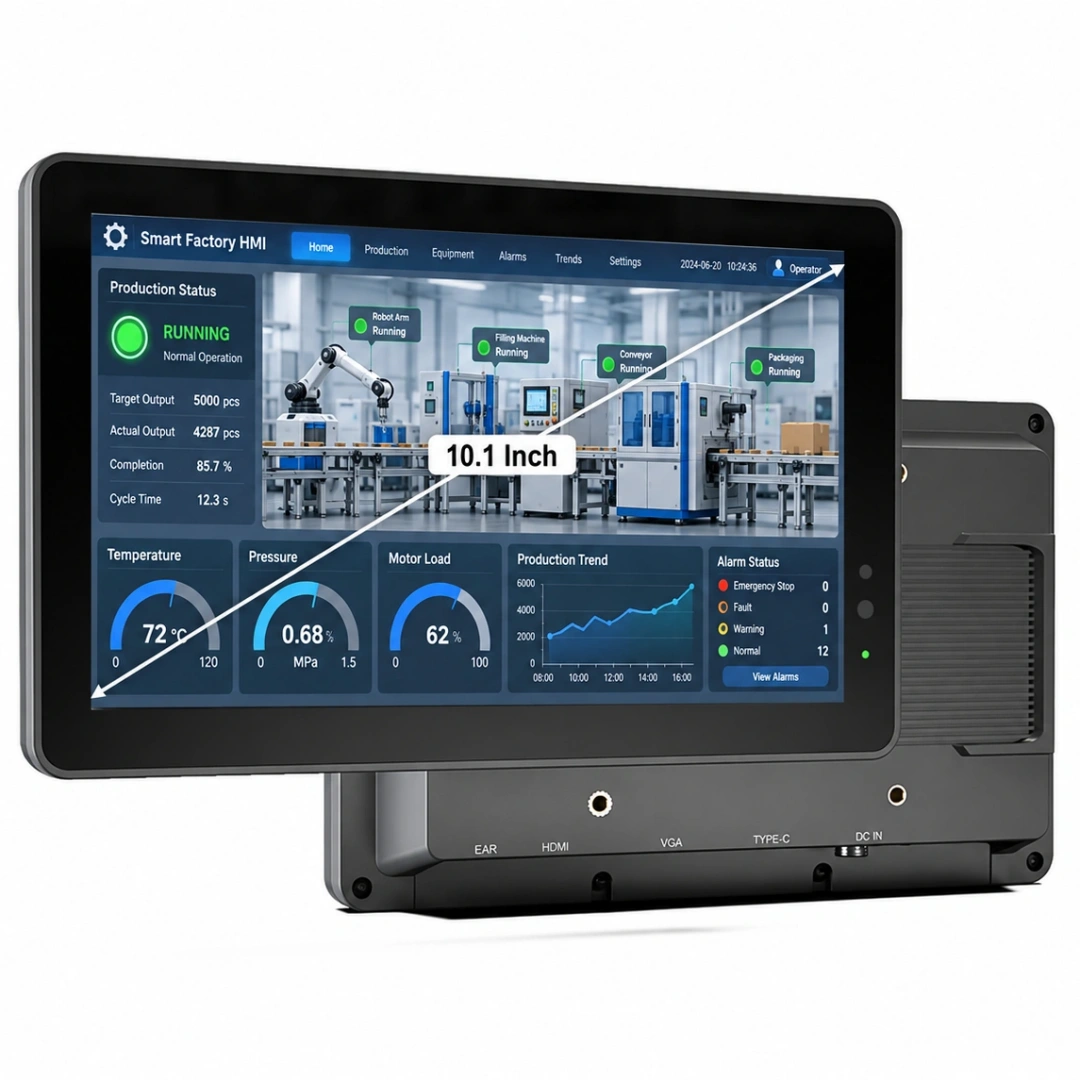
Typical taxi MDT hardware includes a 7–10 inch touchscreen display mounted on the dashboard or console, programmable hardware keys for quick status changes, a speaker and microphone for optional voice features, and sometimes integrated card readers for payment processing. Many units include RS-232 serial ports for taximeter connection and GPIO pins for panic button integration.
Industrial vs. Consumer Devices
The difference between consumer tablets and industrial-grade rugged devices is substantial for demanding environments like taxi cabins:
| Feature | Consumer Tablet | Industrial MDT |
|---|---|---|
| Operating temperature | 0°C to 35°C | -30°C to +70°C |
| Ingress protection | None/IP54 | IP65–IP67 |
| Shock resistance | Limited | MIL-STD-810 equiv. (50g) |
| Vehicle power | USB only | 9–36V DC direct |
| Docking | Consumer stand | Lockable vehicle dock |
| Lifecycle support | 2–3 years | 5+ years |
MDTs are designed to be durable and often include features such as sunlight-readable displays, long battery life, and modular data capture capabilities, making them suitable for demanding work environments. Some fleets use dedicated purpose-built MDT units, while others configure rugged tablets as MDTs via specialized dispatch software installed on Android or Windows operating systems.
How Mobile Data Terminals Fit into a Taxi Dispatch System
A complete taxi dispatch system comprises multiple integrated components working together: a back-office dispatch server running CAD (computer-aided dispatch) software, customer ordering channels (phone lines, mobile apps, web portals), communication infrastructure (cellular modems, sometimes legacy radio), and in-vehicle mobile data terminals. Each MDT serves as the driver-facing endpoint of this system.
Data Flow in Digital Dispatch
The step-by-step process works as follows:
- Booking creation: Customer calls the call center, uses a mobile app, or books via website
- Algorithm assignment: CAD software selects the optimal vehicle based on proximity, availability, and driver ratings
- Job transmission: Trip details push to the selected MDT via 4G/LTE network
- Driver notification: MDT displays the job with an audible/visual alert; driver accepts or declines
- Navigation launch: Accepted jobs trigger integrated navigation with ETA calculation
- Status pings: MDT reports location every 15–60 seconds throughout the trip
- Trip completion: Drop-off triggers payment prompt and automatic log upload to dispatch
Automated dispatching receives job bookings, passenger details, and pickup locations directly from the central Computer-Aided Dispatch (CAD) system, eliminating the need for voice communication of addresses and customer information.
Communication Technologies
Real fleets rely on multiple connectivity options:
- 4G/LTE: Primary data link for most urban and suburban operations (99% coverage in metropolitan areas)
- Wi-Fi: Used in depots for bulk data syncs, firmware updates, and content downloads
- VPN: Encrypted tunnels protect trip data and payment information in transit
- Legacy radio: Some operators maintain private mobile radio as a voice backup, though usage has declined significantly
Two-way communication enables direct, text-based messaging between drivers and dispatchers, reducing reliance on voice radio. Systems that utilize GPS for dispatching can reduce the need for extensive radio communication, as decisions can be made directly by the mobile data terminal (MDT) based on vehicle location.
Integration Points
The MDT connects to multiple vehicle and fleet management systems:
- Taximeter: Serial or CAN bus connection syncs fare data in real time
- Payment devices: POS terminals and receipt printers for cashless transactions
- Cameras: Dual-lens DVRs (road and cabin facing) triggered by MDT events
- Vehicle sensors: CAN bus access for engine data, fuel levels, and diagnostics
This integration creates a complete digital dispatch environment where manual record-keeping gives way to automated data capture.
Core Functions of Taxi Mobile Data Terminals
Mobile Data Terminals (MDTs) can significantly enhance the efficiency of taxi dispatch operations by reducing the need for radio communication, allowing for more streamlined job assignments and improved response times. Below are the core functions that taxi drivers interact with daily.
Job Lifecycle Management
The MDT manages 20–50 jobs per shift in busy urban environments. Incoming jobs display fare estimates, distance, and passenger notes. Auto-offer rules can prioritize high-rated drivers or those closest to the pickup location. When drivers decline, they select from predefined reasons (too far, break needed, vehicle issue), which fleet managers review for performance patterns.
Manual errors in booking, address locating, or dispatching are significantly reduced compared to voice systems—there’s no mishearing of addresses or confusion over passenger names.
Navigation and GPS
Built-in GPS receivers (typically multi-constellation: GPS, GLONASS, BeiDou, Galileo) provide turn-by-turn navigation with accuracy within 3–5 meters. Dynamic rerouting adjusts for traffic conditions, and ETAs remain accurate within ±5 minutes approximately 85% of the time based on field testing.
GPS dispatching utilizes the location of the trip and the location of the car as the means of job assignment, providing the fastest service level. The integration of GPS technology in Mobile Data Terminals allows for real-time tracking of vehicles, which can improve dispatch accuracy and reduce customer wait times.
Location reports transmit automatically to dispatch, enabling geofencing for break zones and service area enforcement.
Digital Communications
Text-style messaging replaces shouted radio communications:
- Dispatch broadcasts: Road closures, surge zones, special events
- Canned responses: Pre-programmed quick replies (“ETA 2 minutes,” “Passenger no-show”)
- Direct messages: Specific instructions for complex pickups
- Receipt of instructions: Special handling notes for VIP accounts or corporate clients
This capability allows dispatchers and drivers to communicate efficiently without occupying radio channels or requiring immediate attention.
Meter and Payment Integration
Linking the MDT to an OIML-certified taximeter enables real-time fare display and automatic trip logging. Automated data logging of speed and mileage reduces manual record-keeping costs. The integration of payment devices such as POS systems and printers in taxi dispatch solutions enhances operational efficiency and customer service by enabling seamless payment transactions.
Modern fleets process cashless payments via NFC (Apple Pay, Google Pay)—in the UK, approximately 40% of taxi transactions are contactless according to 2025 industry data. Credit cards account for over 90% of all card transactions in the taxi industry, making their acceptance crucial for companies to attract business travelers and remain competitive.
Smart cards, which contain a chip for processing and storage, allow for prepaid transactions and can be used for frequent rider programs, enhancing customer loyalty in the taxi industry.
Reporting and Compliance
Automatic capture includes:
- Trip logs with timestamps, locations, and fare breakdowns
- Waiting times and break durations for hours-of-service compliance
- Mileage data synced via odometer or CAN bus
- Adherence reports for local regulations (NYC TLC, London TfL, etc.)
These audit-ready records generate automatically, eliminating manual paperwork. Drivers can handle more trips per shift because they spend less time searching for customers or navigating manually.

Driver Safety and Behavior Monitoring with MDTs
Rising urban safety expectations—passenger assault incidents increased approximately 15% year-over-year according to 2023 NHTSA data—have elevated driver safety to a central concern in taxi fleet management. Modern MDTs incorporate multiple features to protect both drivers and passengers.
Panic Button Integration
Panic buttons are a critical safety feature in many taxi dispatch systems, allowing drivers to alert dispatchers and authorities in emergencies. A physical, easy-to-reach panic button (typically a red mushroom-cap switch) wires directly to the MDT’s GPIO pins. When pressed:
- Silent alarm transmits to dispatch with GPS coordinates
- Driver ID and vehicle number appear on dispatcher screens
- If DVR-linked, a video snippet uploads automatically (1-minute pre-buffer)
- Response time drops to under 30 seconds versus 2+ minutes on voice radio systems
Features like silent emergency alerts and direct messaging improve safety for drivers without alerting potentially dangerous passengers.
Driver Safety Workflows
MDTs prompt pre-trip inspections via on-screen checklists—seatbelt checks, lights verification, brake tests. Post-incident reporting forms allow drivers to document events with photos uploaded directly from the mobile data terminal. These workflows create accountability records and support insurance claims.
Driver Behavior Monitoring
Using 3-axis accelerometers and CAN bus connections, MDTs can track driver behavior patterns:
- Harsh braking: Flagged when deceleration exceeds 0.5g
- Speeding: Alerts when speed exceeds limits by defined thresholds
- Harsh cornering: Lateral acceleration monitoring
Fleet managers access dashboards showing driver safety scores, with targets typically set around 90–92% safe driving compliance. This data supports training decisions and incentive programs.
Driver safety features in taxi dispatch systems often include GPS tracking, which enhances the ability to monitor driver locations and respond quickly in emergencies. Implementing restricted posting in dispatch systems can significantly improve response times and overall safety by ensuring drivers only accept jobs they can reach promptly.
Video and Evidence
Many fleets pair MDTs with dual-lens DVR cameras:
- Road-facing: Captures traffic conditions and potential accident evidence
- Cabin-facing: Documents passenger behavior and fare disputes
- Storage: 2–4TB SSD with H.265 compression for 30-day loop storage
- Resolution: Typically 720p at 30fps for balanced quality and storage
Approximately 60% of EU taxi fleets now utilize integrated camera systems, according to 2024 Transport & Environment data. This documentation reduces insurance premiums by 10–20% through verifiable evidence in dispute resolution.
Hardware Requirements for Modern Taxi MDTs (2024–2026)
Taxi cabin environments present genuine challenges: temperature swings from freezing winters to 70°C summer dashboards, constant vibration, dust, spilled beverages, and accidental impacts. Industrial-grade MDT hardware must withstand these demanding environments while maintaining reliability throughout busy periods, which is why many fleets standardize on rugged tablets and durable industrial devices.
Display and Usability
| Specification | Recommended Range |
|---|---|
| Screen size | 7–10 inches |
| Brightness | 700–1000 nits (sunlight readable) |
| Touch type | Capacitive, glove-friendly (5mm glove support) |
| Panel | IPS for wide viewing angles |
| Protection | Gorilla Glass or equivalent |
High brightness is essential—displays below 700 nits become unreadable in direct sunlight, creating safety risks when drivers must squint or shade screens while navigating.
Performance and Operating System
Current deployments favor:
- Android 12/13/14: Most digital dispatch systems run Android-based apps; AOSP or GMS variants supported
- Windows 11 IoT: Required for legacy CAD systems in some enterprise environments
- Processor: Qualcomm Snapdragon 680+ or Intel equivalents
- Memory: 4–8GB RAM minimum
- Storage: 64–128GB UFS for mapping data and trip logs
OS selection should match your dispatch software requirements—confirm Android version support before procurement.
Connectivity
Essential interfaces for taxi MDT usage include:
- Cellular: 4G LTE Cat-6 (300 Mbps) minimum; 5G NR Sub-6 for future-proofing
- Wi-Fi: Dual-band 802.11ac/Wi-Fi 6 for depot connectivity
- Bluetooth: 5.0+ for peripheral connections
- GNSS: Multi-constellation (GPS, GLONASS, Galileo, BeiDou) for <3m accuracy
- Optional: External antenna connections for improved urban canyon reception
The integration of GPS technology in dispatch systems allows for real-time tracking of vehicles, which enhances the ability to assign jobs based on the closest available driver, thereby improving response times.
Vehicle Power and Mounting
Taxi MDTs require:
- Power input: 9–36V DC direct from vehicle electrical system
- Surge protection: Handle 3–20V surges during engine cranking
- Ignition sensing: Auto-suspend during starter engagement
- Power consumption: Under 10W idle for minimal battery drain
- Mounting: RAM-style ball joints or dedicated vehicle docks with theft-proof locks
Professional installation with fused circuits (typically 10A) prevents electrical issues and ensures reliability for continuous use throughout multi-shift operations.
Durability Standards
| Standard | Requirement |
|---|---|
| Ingress protection | IP65 minimum; IP67 preferred |
| Shock | MIL-STD-810H equivalent (50g) |
| Vibration | 5g per ISO 16750-3 |
| Operating temperature | -30°C to +70°C |
| Impact | IK10 rating |
These specifications ensure devices survive the realities of taxi service—dropped during cleaning, exposed to rain through open windows, subjected to door-slam vibrations.
Expansion and I/O
Custom applications and peripheral integration require available ports:
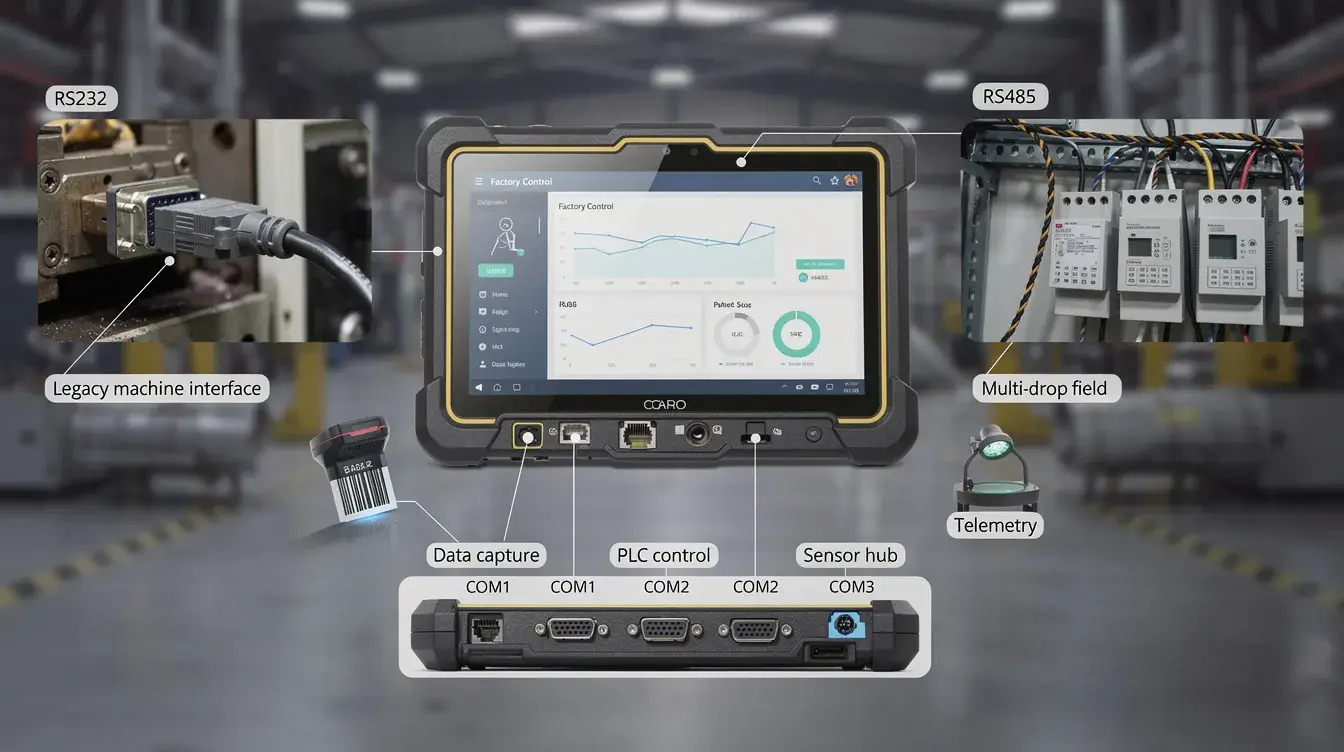
- RS-232/RS-485: Taximeter connection
- USB-A/USB-C: POS terminals, printers, external storage
- GPIO: Panic button, external sensors
- CAN bus: Vehicle data access
- Pogo pins: Optional barcode scanners, NFC readers
Many MDT units offer optional modules, including UHF RFID for package tracking, external GNSS antennas for improved accuracy, and additional serial ports for legacy equipment, similar to configurations used in rugged tablets for the marine industry.

Kcosit Rugged Tablets as Taxi Mobile Data Terminals
Kcosit specializes in rugged Android and Windows rugged tablets for transportation and logistics, frequently deployed as mobile data terminal MDT hardware in taxi, limo, and transportation fleets. As a B2B supplier focused on demanding industrial applications, including diverse rugged tablet industry solutions, Kcosit equipment is designed for the specific challenges taxi operators face.
Typical MDT Configurations
Kcosit vehicle-mounted tablets for taxi dispatch typically include:
- Display: 8–10.1-inch high-brightness screens (1000+ nits), FHD resolution
- Housing: IP65 aluminum enclosures with impact-resistant bezels
- OS: Android 12–14 or Windows 11 IoT
- Processor: Snapdragon or Intel platforms with 4–8GB RAM
- Connectivity: 4G/LTE, dual SIM, Wi-Fi 6, Bluetooth 5.2, multi-constellation GNSS
- I/O: RS-232, USB, GPIO, CAN bus for comprehensive integration
- Docking: RAM-compatible vehicle docks with theft-proof locks
Software Compatibility
Kcosit tablets support leading taxi dispatch software platforms through standard Android APK installation or Windows application deployment. RESTful JSON over MQTT APIs enable integration with custom or white-label dispatch systems. Fleet operators can install their preferred dispatch applications without hardware limitations.
Taxi-Specific Features
Relevant capabilities for taxi services include features that overlap with Kcosit’s broader rugged tablets for the automotive industry:
- Built-in GNSS with optional external antenna support (+10dB gain in urban environments)
- 4G/LTE primary connectivity with dual SIM for carrier redundancy
- Optional dual IR cameras for night vision and cabin monitoring
- GPIO support for external panic button wiring (5V trigger)
- Vehicle power handling for 12V and 24V systems with spike protection to 80V
Accurate, automated routing saves fuel and reduces the need for manual, centralized dispatch staff—Kcosit hardware provides the platform for these efficiency gains.
Project Support
For fleet deployments, Kcosit offers:
- OEM/ODM customization: Custom branding, bezels, port configurations
- Pre-installation: Dispatch software loaded before shipping
- Lifecycle management: 5-year product availability matching extended platform support
- Regional focus: Direct support for the US, UK, EU, Canada, and Australia markets
These project capabilities help system integrators and large fleets deliver unified hardware across hundreds or thousands of vehicles.
Choosing the Right Taxi Dispatch MDT for Your Fleet
Selecting MDT hardware involves more than comparing spec sheets. Fleet managers, IT teams, and system integrators should evaluate devices against their specific operational requirements in 2024–2026 deployments.
Operational Profile Assessment
Before specifying hardware, assess:
- Route environment: Urban (high vibration, stop-start) vs. suburban (longer continuous runs)
- Shift patterns: Single-shift vs. 24/7 multi-driver operations
- Vehicle types: Sedans, minivans, wheelchair-accessible vehicles with different mounting requirements
- Climate: Desert heat, northern winters, or coastal humidity
These factors influence durability requirements, display brightness needs, and power management specifications.
Integration Requirements
Confirm compatibility with your technology stack:
- Dispatch software: Verify Android or Windows version requirements
- Taximeter: Check RS-232 or CAN bus protocol support
- Payment processing: Ensure USB or Bluetooth connectivity for POS terminals
- Cameras: Confirm trigger integration and storage capabilities
- Back-office systems: API compatibility for data export and reporting
Computerized dispatch systems can significantly improve call center efficiency by reducing staffing costs and improving response times through automation and integration with telephone systems.
Total Cost of Ownership
Compare costs across the full deployment lifecycle:
| Cost Element | Consumer Tablet | Rugged MDT |
|---|---|---|
| Unit price | $200–400 | $400–800 |
| Accessories | $50–100 | $100–200 (docks, mounts) |
| Installation | $50 | $100–150 |
| Expected lifecycle | 1–2 years | 4–6 years |
| Replacement cycles (6 years) | 3–6 units | 1 unit |
| Total 6-year cost | $900–2,400 | $600–1,150 |
Rugged hardware typically saves $50,000 per 100 vehicles annually through reduced replacements according to Gartner 2024 analysis. Improved route planning saves fuel and reduces manual record-keeping costs, adding further savings.
Support and Warranties
Evaluate vendor capabilities:
- Regional service coverage and repair depot locations
- Repair turnaround SLAs (48 hours typical for enterprise)
- Spare pool availability for quick swaps
- Firmware and security update policies
- Technical support quality and responsiveness
Scalability Considerations
For fleets deploying hundreds of units:
- Uniform hardware platforms simplify OTA updates and security management
- Consistent interfaces reduce driver training complexity
- Standardized docking allows vehicle-to-vehicle moves
- Bulk procurement provides pricing leverage
Real-time tracking enables accurate passenger pickup times (ETA), building trust and improving service quality—but only when every vehicle runs compatible, reliable hardware.
Implementation Tips for Successful Taxi Dispatch MDT Deployment
Success depends not only on hardware selection but also on installation quality, configuration, and driver onboarding. These implementation practices improve adoption rates and system reliability.
Pilot Phase
Before fleet-wide rollout:
- Deploy 20–50 MDT units across representative vehicle types and routes
- Run pilots for 2–3 months to identify issues
- Test mount locations for driver visibility and reach
- Refine cable routing to avoid interference with vehicle controls
- Gather driver feedback on user interface and screen flows
Pilots reveal real-world problems—overheating in certain vehicles, GPS signal issues in underground lots, or workflow confusion—before they affect the entire fleet.
Installation Standards
Create professional installation documentation:
- Standard wiring diagrams for each vehicle model
- Fused circuits (typically 10A) for MDT power
- Proper grounding to vehicle chassis
- Cable routing away from airbag zones and moving parts
- Testing procedures for ignition on/off and engine cranking behavior
Use qualified installers familiar with vehicle electrical systems. Poor installation causes the majority of early MDT failures.
Driver Training
Effective training covers:
- Job acceptance and status update workflows
- Panic button usage (emphasize proper scenarios to minimize false positives)
- Messaging and canned response selection
- Safe screen interaction while stopped vs. moving
- Troubleshooting basics (restart procedures, connectivity checks)
Short, scenario-based sessions of 30–45 minutes achieve higher acceptance than lengthy classroom instruction. Target acceptance rates above 90% within the first month.
Security and Updates
Establish clear policies for:
- OS updates: Quarterly security patches with staged rollouts
- Dispatch app versions: Coordinated updates across all vehicles
- MDM enrollment: Mobile device management for remote monitoring and control
- Remote wipe: Capability to wipe devices if stolen
- BIOS/firmware passwords: Prevent unauthorized system access
Performance Monitoring
Track key metrics during the first 90 days:
- Job acceptance rate (target: 95%+)
- Average response time
- System uptime (target: 98%+)
- Driver-reported issues and support tickets
- GPS accuracy and connectivity reliability
Different types of computerized dispatch systems include computer-assisted voice, zone-based dispatch, and GPS dispatch, each with its own advantages and disadvantages in terms of cost and service efficiency. Monitoring reveals whether your chosen system type meets operational needs.
Implementing restricted posting in dispatch systems can reduce customer wait times by ensuring that drivers can only accept jobs in areas they are physically near, thus improving overall service efficiency.

FAQ
Can we use consumer tablets instead of rugged mobile data terminals for taxi dispatch?
Consumer tablets can function in small pilots or very mild operating conditions, but they typically fail faster in real taxi environments. Heat cycling (dashboard temperatures reaching 70°C), constant vibration, accidental drops, and non-locking mounts all contribute to premature failures. Field data suggests consumer tablets fail at approximately three times the rate of industrial MDTs in taxi applications, with many units failing within the first year.
Rugged mobile data terminals and Kcosit vehicle-mounted tablets are engineered for 24/7 vehicle use. Secure docking, wide-voltage power input, IP65+ sealing, and MIL-STD-style shock resistance extend operational lifecycles to 4–6 years. Many fleets that switched from consumer tablets to rugged MDTs report substantially lower downtime and fewer driver complaints across 3–5 year deployment periods.
For operators considering the market, the total cost of ownership calculation typically favors rugged equipment despite higher upfront costs.
How does an MDT improve driver safety compared with traditional radio-only systems?
MDTs enable capabilities impossible with voice radio alone. Silent panic alerts transmit GPS coordinates, vehicle ID, and recent trip data to control rooms without audible indicators that might escalate dangerous situations. Continuous GPS tracking means dispatchers always know exact vehicle locations—there are no “check-in” gaps where a driver’s status becomes unknown.
Clear on-screen navigation reduces distracted driving and wrong-turn stress. Integrated cameras and trip logs deter aggressive behavior from both drivers and passengers while providing evidence for dispute resolution. Dispatchers respond faster in emergencies because they see real-time vehicle location and recent trip details simultaneously.
The integration of GPS technology in taxi dispatch systems has been shown to improve response times by ensuring that drivers are only able to accept jobs in areas they can reach quickly.
What network connection is best for taxi mobile data terminals: radio, 4G/LTE, or Wi-Fi?
Modern taxi fleets typically rely on 4G/LTE as the primary data link, with coverage exceeding 99% in metropolitan areas. 5G is emerging for latency-sensitive applications, though 4G remains sufficient for standard dispatch, navigation, and messaging functions.
Wi-Fi serves depot environments for bulk data operations—firmware updates, mapping downloads, video uploads—where cellular data costs would be excessive. Some operators maintain legacy private mobile radio as backup for voice communication, though digital dispatch systems have reduced this dependency by 80–90%.
When planning deployment, consider local coverage quality (especially in parking garages, tunnels, or rural pickup zones), potential roaming needs across city or national boundaries, and data plan management for fleet-scale cellular usage. Pooled data plans typically offer better economics than per-device allocations.
Can Kcosit MDT hardware be customized for specific taxi projects?
Kcosit supports OEM/ODM projects with minimum order quantities typically starting around 1000 units for significant customization. Available customizations include:
- Custom branding with fleet logos on bezels and boot screens
- Pre-installed taxi dispatch software configured for immediate deployment
- Specific I/O configurations (additional serial ports, particular GPIO arrangements)
- Camera integrations (dual-lens options, night vision variants)
- Accessory packages (docks, antennas, cabling) bundled per vehicle type
For efficient project scoping, prepare a clear requirement list covering screen size, operating system, required ports, camera specifications, panic button wiring, and any regulatory certifications. Kcosit’s project teams work with system integrators to deliver integrated solutions while maintaining hardware serviceability.
How long should a taxi dispatch MDT remain in service before replacement?
Most taxi fleets plan for a 4–6 year service life for rugged mobile data terminals, depending on factors like annual mileage, climate severity, and technology evolution. Kcosit offers industrial product lifecycles with parts availability designed to support multi-year deployments without forced platform changes.
However, hardware review every 3–4 years is advisable to confirm that CPU performance, OS support, and connectivity standards still meet operational needs. The 3G network sunset in 2022 forced approximately 40% of US fleets to upgrade MDTs—similar transitions may occur as 4G eventually phases out in favor of 5G.
Plan replacement cycles around operating system end-of-life dates as well. Android versions typically receive security updates for 3–4 years; deploying devices near OS end-of-life reduces effective service life. Kcosit’s extended support programs help mitigate these transitions.